



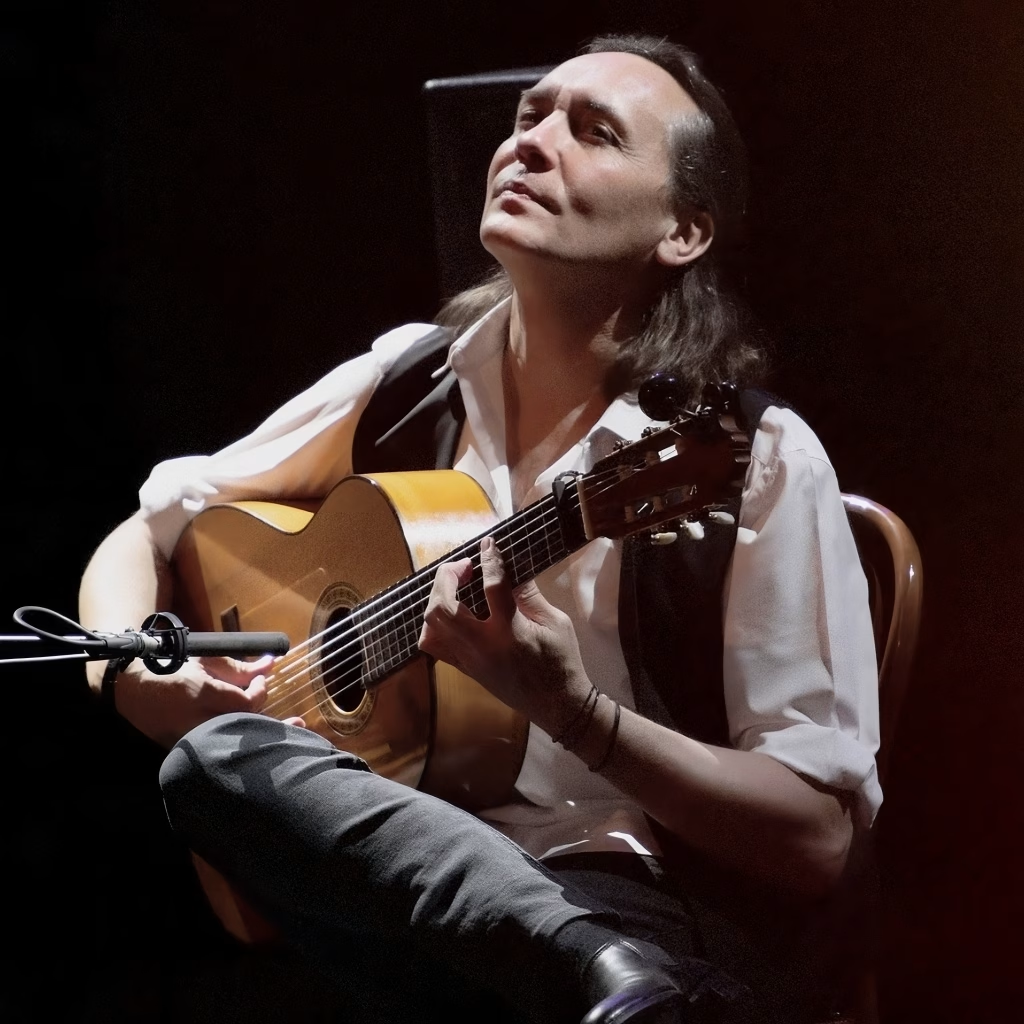
Are you looking for a ranking of the best flamenco guitarists in history? You’re right to look here: flamenco is probably one of the richest and most technically demanding musical genres out there, and its guitar has produced names that have influenced not only Spain, but also jazz, rock, and classical musicians worldwide.
From the pioneers who laid the foundations of flamenco guitar playing to contemporary virtuosos who continue to reinvent the genre, this tradition boasts over a century of history, schools, and styles (Jerez, Sanlúcar, Granada) that are worth knowing if you truly want to understand what makes flamenco guitar special.
I’ve been listening to flamenco for years, almost without realizing it, and one day I sat down to jot down the names that have left the biggest mark on me.
What follows is more or less that notebook, tidied up but without losing the disarray of ideas that emerge when one writes from memory and by ear.
This is not an academic list, nor does it claim to be the absolute truth; it is, simply, my selection of the most important flamenco guitarists of all time, intended for anyone who wants to discover—or rediscover—the great masters of this art.
1. Ramón Montoya
He has to be first, almost by historical obligation. He’s the guy who took the flamenco guitar, which until then was little more than an accompaniment to singing, and turned it into something capable of standing on its own. He recorded extensively in the 30s and 40s, and if you listen to his tarantas or granaínas even today, you can still feel that sense of inventing a new language. Without him, probably nothing that came after would sound the same.
2. Niño Ricardo
For me, he’s one of those names that remain somewhat in the shadow of giants, but any self-respecting guitarist recognizes him as a master.
His way of playing por soleá, his manner of embellishing without being cloying, directly influenced entire generations. In fact, some say that without Ricardo, there would be no Paco de Lucía, and I don’t think that’s an exaggeration.
3. Paco de Lucía
It’s hard for me to be objective here because he’s probably the reason many people of my generation fell in love with flamenco guitar.
Paco’s genius wasn’t just virtuosity, which he had in spades, but a rare ability to blend tradition and modernity without it sounding forced. His work with Camarón is already heritage, but so is his more jazz-oriented period, with the sextet, with Al Di Meola, with Chick Corea.
He changed the rules of the game: after him, flamenco guitar is no longer understood in the same way, neither technically nor harmonically.
4. Sabicas
A Navarro native who went to America and became a parallel legend there, almost a myth that many in Spain took a long time to fully appreciate.
His technique was devilish for his time, and his influence on guitarists outside of flamenco—even in rock and jazz—is undeniable.
5. Manolo Sanlúcar
For me, he represents the other side of flamenco modernity: the more reflective, almost classical in its construction. His compositions have an architecture that invites careful listening, not just getting carried away.
Albums like Tauromagia show a guitarist thinking of flamenco as a way of narrating, not just playing.
6. Vicente Amigo
He took the baton from the generation after Paco and brought it to his own unique place, with a melodic sensibility that sometimes seems almost like a film composer’s. His “Tres notas para decir te quiero” is one of those pieces that, even if you know nothing about flamenco, stays with you.
7. Diego del Gastor
Much more underground, much less commercial, but absolutely revered by the purists of Morón flamenco. His playing, rough and deeply jondo, represents that other side of flamenco that doesn’t seek easy applause but the truth of the moment.
8. Tomatito
He was Camarón’s right-hand man for years, and then built his own career full of nuances, with an ability to accompany cante that many consider unsurpassed. His playing has that hard-to-explain quality of sounding elegant and raw at the same time.
9. Moraíto Chico
Camarón’s quintessential accompanist in his later years and an essential guitarist of Jerez flamenco. His playing has that neighborhood feel, direct and without unnecessary embellishments, which many consider the purest essence of the Gypsy compás. Listening to him is understanding why some say flamenco is best learned in a home rather than a conservatory.
10. Gerardo Núñez
Representative of a more recent generation, with a background that blends flamenco with jazz harmony and contemporary music.
His compositions have a complexity that never abandons the compás, and his work as a pedagogue (with his school in Sanlúcar) has trained many of the young guitarists who perform today.
And a few more I didn’t want to leave out
I could go on, of course: Pepe Habichuela, Rafael Riqueni, Manolo Franco, each with their own world, their own school, their own way of understanding the compás.
My pocket summary.
If I had to pick just a handful of names to explain what flamenco guitar is to someone, I’d probably say:
- Montoya for the foundations
- Ricardo for the bridge
- Paco for the revolution
- Sabicas for the diaspora
- Sanlúcar for depth
- Amigo for melody
- Diego del Gastor for purity
- Tomatito for craftsmanship
- Moraíto for the roots
- Gerardo Núñez for the future
The curious thing about all this is that the more I listen, the more names are added to my list, and the less sure I feel about having closed it properly.
Perhaps that, in the end, is the best sign that flamenco is still alive: that the list of those who deserve to be on it never ends.
And if you ask me why it matters so much to me to organize these names in a notebook, I think the answer is simple: each of these guitarists not only played strings, but left a distinct way of feeling the compás, of breathing between silences, of telling something without words.
Listening to them consecutively, one after another, is like flipping through a family album where each photo has a different accent but all speak the same language. So this list, more than a closed ranking, is an invitation: press “play”, listen carefully, and let your own ear decide who deserves another star.